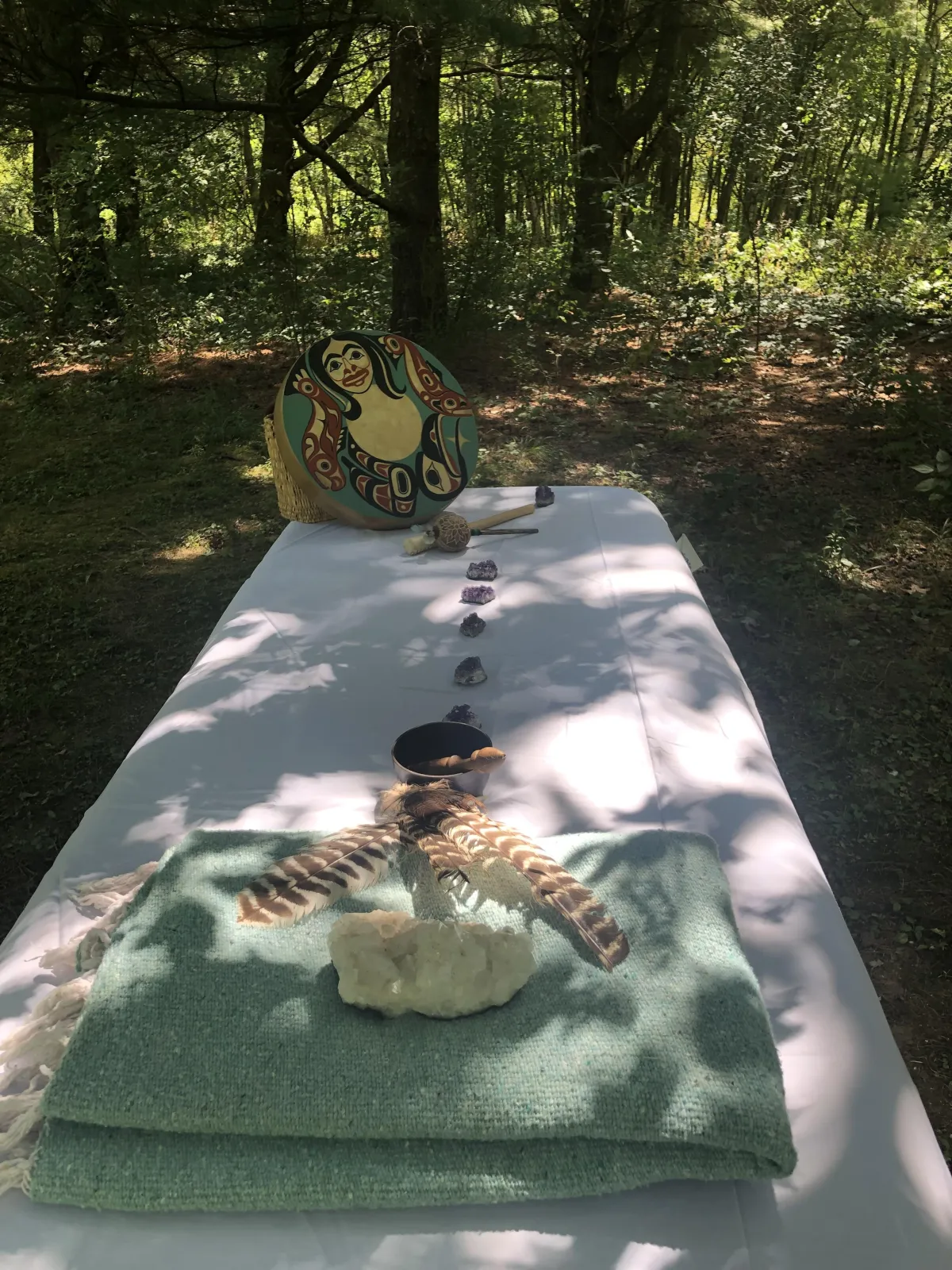
Shamanic Healing for Trauma: A Journey Across Time and Space
Originally published June 30, 2025; thoughtfully updated in 2026.
There may be a reason you found your way here.
Perhaps something inside you is stirring—an ache you cannot quite name, a heaviness that has not lifted, or a quiet curiosity about patterns that continue to appear in your life.
You may have done a great deal of healing already and still sense that something remains unresolved. Or perhaps you are only beginning to recognize how an experience from your past continues to shape the way you feel, relate, or move through the world.
I want you to know that you are not alone.
Shamanism is among humanity’s oldest spiritual healing traditions. Across many cultures, shamanic practitioners have understood that suffering can affect more than the thinking mind. Pain may be felt in the body, carried in the spirit, echoed through family systems, or associated with the history of a place.
From a shamanic perspective, healing is not always linear, and it is not limited to what can be seen.
Shamanic healing offers practices intended to restore connection, balance, and vitality. It does not ask us to define ourselves by what happened. It invites us to remember the wholeness that exists beneath the wound.
Understanding Trauma Through a Shamanic Lens
Trauma is commonly understood as the lasting emotional, psychological, and physiological effects of an overwhelming or deeply distressing experience.
Shamanic traditions may also view trauma as a disruption within a person’s spiritual or energetic wholeness. After loss, betrayal, abuse, abandonment, illness, or another life-altering event, someone may feel that a part of them has become distant or inaccessible.
They might say:
I have never felt like myself since.
Something in me disappeared after that happened.
I feel disconnected from my joy, confidence, or sense of purpose.
Shamanic healing gives spiritual language to experiences like these. Rather than treating the person as broken, it recognizes that withdrawing, shutting down, or separating from certain feelings may have been a protective response during a difficult time.
The same lens can be extended to ancestral patterns and the places where we live. Grief, fear, displacement, violence, and oppression may leave echoes that affect families and communities long after the original events have passed.
Shamanic practices seek to bring compassionate attention to these disruptions and help restore relationship—with the self, the ancestors, the land, and the sacred.
Soul Retrieval: Reconnecting With What Was Lost
Soul retrieval is one of the best-known practices in shamanic healing.
In traditional shamanic understanding, overwhelming experiences can lead to what is sometimes calledsoul loss. This does not mean that your soul is permanently damaged or that you are incomplete. It describes the sense that an essential quality—perhaps trust, playfulness, courage, creativity, or hope—became separated from your everyday awareness during a painful experience.
You may recognize this feeling in the words, “A part of me never came back.”
During a soul retrieval, the practitioner enters a shamanic journey on the client’s behalf. With the support of compassionate helping spirits, the practitioner seeks the essence, strength, or soul quality that is ready to return.
The purpose is not to relive the traumatic event. It is to reconnect with the life force and inner resources that may have become difficult to access afterward.
Integration Is Part of the Healing
A soul retrieval is not a magical erasure of the past. What happened remains part of your history, and meaningful healing often requires care on several levels.
After a session, you may be invited to welcome the returning quality through journaling, movement, time in nature, ceremony, creative expression, or practical changes in your life. If courage has returned, for example, you might honor it by establishing a needed boundary. If joy has returned, you may begin making space for play.
The spiritual experience becomes most meaningful when it is gently integrated into daily life.
Ancestral Healing: Changing What Travels Through the Family Line
Not every pattern begins with us.
Families can pass down love, resilience, wisdom, traditions, and belonging. They can also pass down unprocessed grief, fear, shame, silence, and survival strategies.
You may recognize a pattern that seems larger than your individual experience:
A fear that does not appear connected to anything in your own life
Repeated relationship dynamics across several generations
Persistent beliefs about scarcity, worthiness, or safety
Family secrets or subjects no one is permitted to discuss
Grief that was never acknowledged or expressed
A sense of carrying responsibility for everyone else
Psychology may understand some of these experiences through family systems, learned behavior, or intergenerational trauma. Shamanic traditions may also approach them through ceremony, spiritual relationship, and ancestral healing.
Honoring the Past Without Remaining Bound to It
Ancestral healing might include acknowledging what happened, grieving what was never grieved, expressing gratitude for the strength that allowed a family to survive, or releasing a role or burden that no longer belongs to you.
The purpose is not to blame your ancestors or invent a story about the past. It is to meet inherited patterns with curiosity, compassion, and discernment.
We can honor those who came before us without repeating everything they carried.
Choosing to interrupt a harmful pattern can be an act of love—for yourself, for your ancestors, and for the generations who will follow you.
Healing Our Relationship With the Land
Shamanism recognizes the Earth as alive and worthy of relationship rather than merely a collection of resources for human use.
Places have histories. A home, property, community, or landscape may have witnessed conflict, displacement, neglect, illness, grief, or environmental harm. Whether we understand the effect spiritually, emotionally, historically, or symbolically, people often sense when a place does not feel settled.
A land blessing or land-healing ceremony begins with listening.
Rather than assuming that a practitioner knows what a place needs, the practice may involve connecting with the spirit of the land, learning its history, acknowledging what occurred there, and asking how balance might be restored.
Ceremony may include prayer, offerings, sound, water, smoke where appropriate and safe, or expressions of gratitude. Practical care matters, too. Removing waste, protecting water, planting native species, and treating the land respectfully can all become sacred acts.
Relationship Before Ritual
A land blessing is not simply an energetic cleaning performed to make a property more comfortable for its human occupants. It is an opportunity to enter a more respectful relationship with the place itself.
Sometimes the first healing act is to acknowledge the original stewards of the land, learn what has been forgotten, or listen before asking for anything.
Healing the land and healing ourselves are not separate endeavors. As we tend our relationship with the Earth, we often become more rooted within our own bodies and lives.
Extraction Work and Energetic Clearing
In shamanic practice, extraction work is used to address energy that is understood to be intrusive, stagnant, or no longer serving the person.
This language can sound alarming, but it does not need to imply anything frightening or supernatural. A responsible practitioner should never use fear to convince you that something dangerous is attached to you or that only they can remove it.
I think of extraction as a form of spiritual and energetic clearing.
Stressful experiences, unhealthy relationships, prolonged grief, and environments that require us to remain guarded can leave us feeling heavy, depleted, or unlike ourselves. A practitioner may use their hands, breath, rattles, feathers, drumming, prayer, or other traditional tools to support the release of this energetic residue.
The intention is to create space for your natural vitality and sense of connection to return.
As with soul retrieval, extraction work is not a substitute for medical or psychological care. Fatigue, chronic pain, anxiety, depression, and other persistent symptoms deserve appropriate evaluation from qualified healthcare professionals.
Spiritual healing can be a meaningful companion to conventional care, but it should not be used to diagnose illness or discourage necessary treatment.
Healing Across Time and Space
One of the qualities I value most about shamanic practice is its understanding that healing is not confined to a single moment.
A painful experience may have happened many years ago, yet the younger version of you who endured it may still need compassion, protection, or acknowledgment. An ancestral story may have begun before you were born, yet you may be the person who becomes conscious of the pattern. A place may carry a history that was never spoken aloud, yet still invite remembrance and care.
Shamanic journeying allows us to engage these experiences through spiritual relationship, symbolism, ritual, and expanded awareness.
This does not mean changing the historical facts or pretending something did not happen. It means changing the relationship we have with what happened.
We may not be able to rewrite the past, but we can reclaim energy that has remained tied to it. We can bring compassion to the parts of ourselves that were left alone. We can choose what we will carry forward and what we are ready to lay down.
Shamanic Healing and Trauma-Informed Care
Trauma healing requires sensitivity, consent, and respect for the pace of the person receiving support.
A shamanic practitioner should explain what they are doing, honor your boundaries, and never pressure you to disclose more than you wish to share. You should remain free to pause or stop a session and to decide what meaning—if any—you give to the practitioner’s impressions.
Spiritual experiences can be powerful, but they should not be presented as unquestionable truth. You remain the authority on your own life.
For many people, the most supportive approach combines spiritual practice with trauma-informed therapy, medical care, healthy relationships, nervous-system support, and practical changes. These forms of care do not compete with one another. Each may tend to a different dimension of healing.
If you are experiencing severe anxiety, depression, flashbacks, thoughts of harming yourself, or difficulty functioning, please seek support from a licensed mental health or medical professional. Shamanic healing is complementary spiritual care, not crisis treatment or a replacement for qualified clinical support.
Restoration in the Seen and Unseen
Shamanic healing does not begin with the belief that you are broken.
It begins with the understanding that beneath the adaptations, protective patterns, pain, and disconnection, something essential within you remains whole.
A soul retrieval may help you reconnect with a forgotten quality. An ancestral ritual may help you release a burden that was never truly yours. Extraction work may create a sense of spaciousness. A land blessing may renew your relationship with the place that holds you.
The work may be subtle or profound. You may experience immediate insight, or its meaning may unfold gradually over days and weeks.
Healing is not always the absence of pain. Sometimes it is the return of choice, connection, self-trust, and the ability to feel fully present in your own life.
Begin Your Healing Journey
If something here speaks to you—if you feel a gentle tug or a quiet sense that this work may support you—I invite you to listen.
You do not need to force an answer or commit before you feel ready.
Shamanic healing is not about fixing what is wrong with you. It is an invitation to remember who you are beneath what happened and to reconnect with the inner resources, spiritual support, and sense of belonging that trauma may have obscured.
You do not have to make that journey alone.
If you would like to explore whether shamanic healing is appropriate for you, we can begin with a Soul Chat. It is a simple conversation about what you are experiencing, what kind of support you are seeking, and whether my approach feels right for you.
There is no pressure—only an opportunity to listen together for the next honest step.


